
By Dr. Kimmo Soramäki
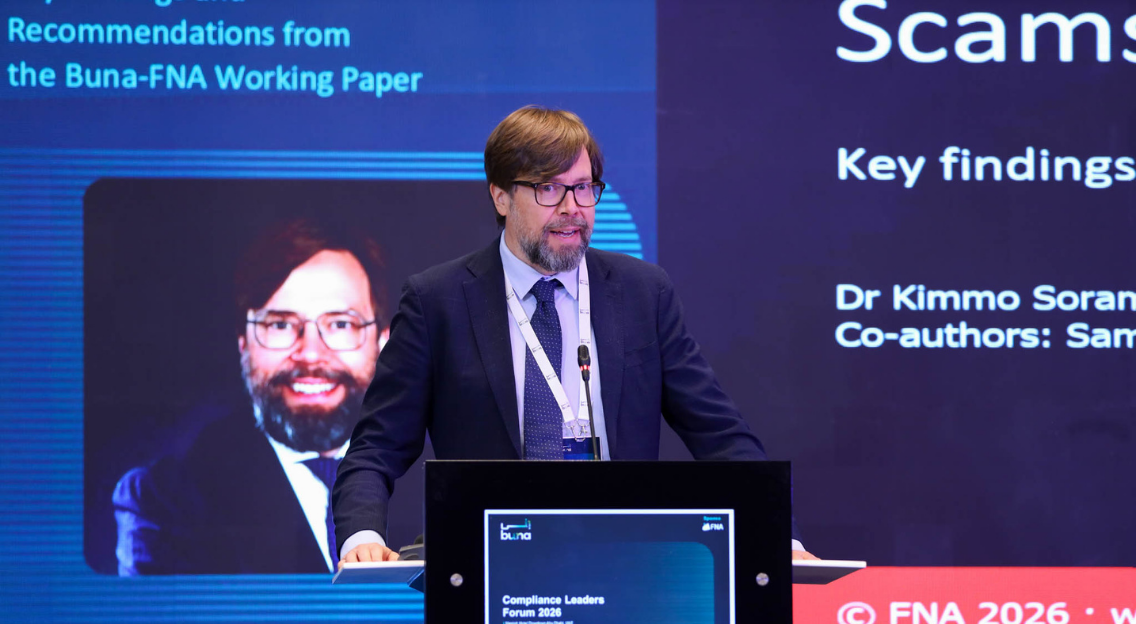
On 21 October, I spoke at the Buna Compliance Leaders Forum in Abu Dhabi. I presented a working paper, Countering Cross-Border Fraud and Scams in Arab Countries, which I wrote with Samira Neaimeh of Buna and Matteo Neri of FNA. Here is the argument I made.
Many countries are building national capabilities against fraud. The International Monetary Fund (IMF) and the World Bank’s Bangkok Blueprint, released on 14 October, calls for approaches that cover the whole financial system. Yet scam proceeds can move to another country within minutes. Each Arab country needs a national capability to trace and freeze stolen funds. Those capabilities then need to be connected, and Buna already has the connections, rules, and oversight to coordinate that work.
Scam losses are already regional
In a survey by the UAE Cybersecurity Council, 27% of respondents had lost money to scams. Only 9% recovered their losses in full. The Global Anti-Scam Alliance estimates consumer scam losses at USD 442 billion across the 42 markets in its 2025 survey, for the preceding 12 months. Interpol has identified scam centres in at least 25 countries and names the Middle East as a new area of activity.
The IMF and the World Bank are concerned that repeated scams undermine trust in digital payments and financial institutions, with consequences for financial inclusion, integrity, and stability. Our paper, written before the Blueprint, contributes mainly to its pillar on domestic and cross-border cooperation.
Start with a national anti-scam capability
Cross-border cooperation needs a capable counterpart in each country. A regional alert helps only if a national system receives it and can act on it in minutes.
We call this counterpart a national anti-scam utility: a coordinated national capability to detect, trace, freeze, and recover funds, and to apply payment data analytics to the results. Alongside tracing, the utility scores account and transaction risk, shares fraud intelligence securely among authorised institutions, and keeps a single case record of reports, actions, and progress. A central bank can operate it directly. So can a financial market infrastructure under central bank oversight, a consortium owned by the banks, or a federated arrangement in which institutions keep their own systems and connect through common standards. The choice depends on the legal mandate for data sharing, the coverage of the payment infrastructure, and who can operate it.
In Malaysia, the government set up the National Scam Response Centre in 2022 as a joint initiative of agencies, regulators, and industry, including Bank Negara Malaysia. The central bank then designated PayNet, which operates the national real-time payment system, to run the National Fraud Portal. More than 50 institutions and 500 case officers use one platform. Malaysia’s Deputy Minister of Finance told Parliament in October 2024 that the portal had cut the time to trace funds by 75%, to 30 minutes, and raised the amount of funds frozen by 28%. FNA provided the technology for the portal, and two of the paper’s three authors work for FNA.
Indonesia organised the capability differently. The Anti-Scam Centre under the Financial Services Authority (OJK) receives victims’ reports and coordinates account blocking across banks. Between November 2024 and 16 October 2025 it received 299,237 reports, blocked 94,344 accounts, and IDR 376.8 billion (Indonesian rupiah) in funds, according to figures reported by Antara News. Each authority reports on its own basis, so the two sets of results are not directly comparable.
The Central Bank of the UAE is establishing its Anti-Fraud Operations Center (CAFOC) as an operational and intelligence hub with tracing tools and escalation procedures. CAFOC has not yet reported results. Three other Arab central banks are at earlier stages.
Scam proceeds leave the country within minutes
The first fraudulent payment is usually domestic. The second or third transfer moves the funds to an account abroad. From that point, a national utility has no data on the next transactions. Its freezing orders have no effect abroad and are rarely recognised by foreign authorities in real time. Intelligence is held under separate privacy regimes, and police in each country repeat the same investigative steps.
In Europe, cross-border transactions accounted for 71% of card fraud and 43% of credit transfer fraud by value in the first half of 2023, according to the European Banking Authority (EBA) and European Central Bank (ECB) 2024 report on payment fraud. Payments settle in seconds. Requests between financial intelligence units take days or weeks.
Buna is adding links with national instant payment systems, including Pakistan’s Raast. Without fraud coordination, criminals get the same speed as customers.
Four building blocks connect national utilities across borders
The paper sets out four building blocks. Jurisdictions can adopt them one at a time, as their readiness allows.
Track and trace across borders. A unique end-to-end transaction reference (UETR) in ISO 20022 messages identifies one payment through its processing chain. The UETR does not link that payment to later transfers through mule accounts. Common references let countries match the cross-border payment; each country’s own tracing, and its answers to authorised queries from the others, establish where the funds went next. Each country keeps its own payment data, and no central repository is needed.
Secure exchange of fraud intelligence. Hashing and multiparty computation let institutions match fraud data without disclosing personal data. Swift reports that in its 2025 experiments with 13 banks, using 10 million artificial transactions, the collaborative model was twice as effective at identifying known fraud as a model trained on one institution’s data.
Consumer case transparency. Victims usually receive no information once their case is referred abroad. Structured status updates, such as “funds located” or “recovery in progress”, can be returned through the victim’s own national utility. Pooling scam reports across countries also lets authorities identify campaigns that run in several at once.
Privacy-preserving identity exchange. Multiparty computation can confirm that a suspect identity appears in two jurisdictions without disclosing it to either, under disclosure rules, the participating countries agree.

Buna already has what a regional fraud hub needs
Buna is the Arab region’s cross-border payment system, established by the Arab Monetary Fund. With 22 Arab countries, bilateral links between every pair of national utilities would mean up to 231 connections to build and maintain. Under a hub-and-spoke model, each utility connects once, and the hub turns national utilities into a regional anti-fraud network. Every participant has to trust the hub.
Buna meets five conditions for that role. It connects more than 100 financial institutions across borders. Its rules define participants’ roles, responsibilities, and liabilities. It is overseen by the central banks whose currencies it settles. Its operator, established by the Arab Monetary Fund, has supranational status and specified privileges and immunities. Buna already screens payments for fraud before settlement and can suspend suspicious payments.
Malaysia offers a relevant institutional parallel: the central bank sets policy, and a trusted payment infrastructure operator runs the shared platform.
Extending Buna’s existing compliance controls to act on signals from national utilities would require agreed legal and operational arrangements. The legal basis for pausing a payment on such a signal, its interaction with settlement finality, liability for an inaccurate signal, and who sets thresholds are decisions for Buna’s Board, its participating central banks, and national authorities. The paper takes no position on them.
Design every new national anti-scam utility to connect across borders from the start: common transaction identifiers, standard query interfaces, and payment data that stays in the country. A utility built this way can join a regional network at a lower cost when the region is ready.
The full working paper, Countering Cross-Border Fraud and Scams in Arab Countries, is available here
Frequently asked questions
What is a national anti-scam utility?
A national anti-scam utility is a coordinated national capability to detect, trace, freeze and recover scam proceeds, and to analyse the resulting data. The utility also scores account and transaction risk, shares fraud intelligence among authorised institutions, and keeps one case record. A central bank, a financial market infrastructure under central bank oversight, a bank-owned consortium, or a federated arrangement can operate one.
Why does cross-border fraud need regional coordination?
Scam proceeds usually move abroad by the second or third transfer, and a national utility has no data on transactions outside its own country. In Europe, cross-border transactions accounted for 71% of card fraud by value in the first half of 2023. Payments settle in seconds, while requests between financial intelligence units take days or weeks.
How can countries trace scam payments across borders without pooling their payment data?
Countries can use common transaction references, such as the unique end-to-end transaction reference (UETR) in ISO 20022 messages, to match a cross-border payment. Each country then traces onward flows within its own data and answers authorised queries from the others. No central repository is needed.
Why is Buna suited to run a regional anti-fraud network for Arab countries?
Buna connects more than 100 financial institutions across borders, operates under rules that define participants’ roles and liabilities, and is overseen by the central banks whose currencies it settles. Buna already screens payments for fraud before settlement. A hub-and-spoke model through Buna means each national utility connects once, instead of the region building up to 231 bilateral links.
