
The first users of agentic payments will be simulated agents
By Dr. Kimmo Soramäki
Is Liquidity About to Run Itself? Agentic AI and the Future of Payment Systems
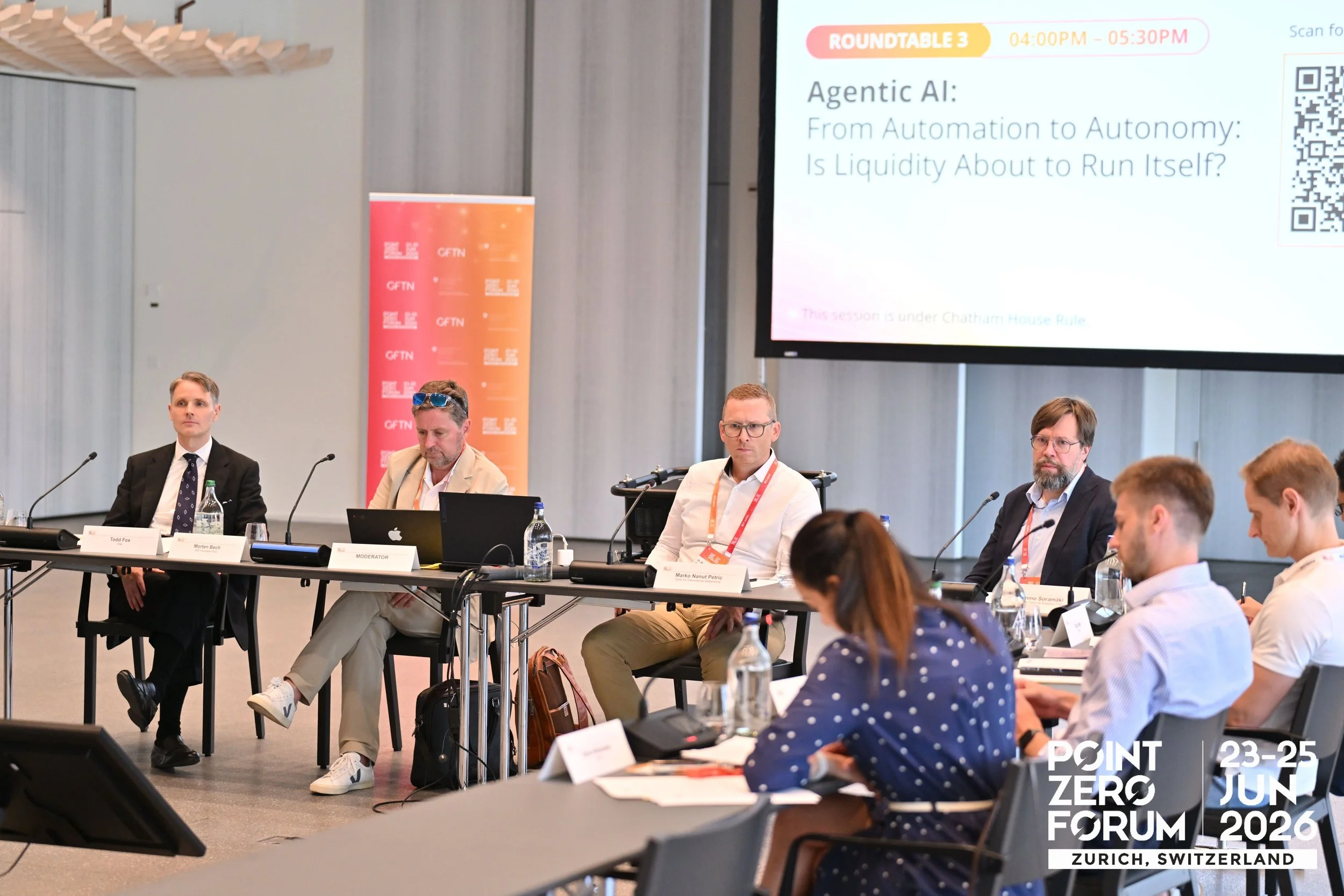
At Point Zero Forum in Zurich I spoke on a roundtable on agentic AI and payments, moderated by Morten Bech of the BIS Innovation Hub. The session spanned traditional and on-chain rails and covered the expected questions: systemic risk, design principles for safe agent-based payments, and where regulators need to coordinate. My answer to the panel's title, "is liquidity about to run itself," was that autonomy in payments should begin where liquidity design has always begun, in simulation. The first users of agentic payments will be simulated agents.
Simulation has always done the heavy lifting
Nearly thirty years ago I built a payment system simulator at the Bank of Finland, to work out how much intraday liquidity banks would need to settle their payments as the country moved to the single currency. You cannot answer that on paper. You run the payments through a model of the system and watch the queues and balances under different liquidity levels.
That method became standard. Using a central bank simulator, authorities now size liquidity, test settlement logic, and see how a system holds up when a large participant fails or a market freezes. Around the same time, Morten and I worked on the gridlock problem: what happens when banks each hold back payments while waiting for incoming funds that are themselves stuck in someone else's queue. We described an algorithm that clears these positions by settling a batch of offsetting payments together rather than one at a time. A version of that logic, the liquidity-saving mechanism, is now common in modern RTGS systems, and it lets banks settle the same volume with far less liquidity.
AI adds behavioural realism, not exact clearing
Agentic AI changes what we can put inside the simulation. Banks in these models used to follow fixed submission rules: release a payment when a condition holds, otherwise queue it. With AI agents we can model a bank closer to how it behaves, as a decision-maker weighing the cost of liquidity against the cost of delay, reacting to other banks, and learning over time. That brings us close to a working digital twin of an RTGS system and the institutions on it.
The temptation is to hand AI the whole job. It cannot take the part that has an exact answer. Finding the set of offsetting payments that clears the most volume for the least liquidity is an intelligent liquidity optimization problem; you want an algorithm that solves it, not a model that lands near it. Predicting how a bank behaves under stress, or how flows shift when conditions change, is fuzzy, and that is where agentic AI belongs. Liquidity is a network problem, and a bank's ability to pay depends on whether the banks upstream have paid it, so coordination is exactly the layer agents can manage: timing, congestion, queue decisions through the day. AI agents may run the system; optimization is what makes it efficient.
RTGS modernisation programmes must build for autonomous agents now, not retrofit later
This is worth designing in now, while teams are still writing the new systems. Many RTGS modernisation programmes still centre on human-initiated payments, operator-set rules, and conventional queue management. That made sense for the world they were built for. It leaves little room for autonomous agents acting on a bank's behalf, and adding that later costs far more than building for it today.
Retail schemes need simulated users before real ones
The same principle shows up more sharply in retail. At financial network analytics firm FNA, we are coordinating Raha, an open payment scheme, and much of the design work is about agent-to-agent payments: one piece of software paying another with no human present when the payment happens. That removes the person who would normally authorise, catch a mistake, or abandon a purchase that feels wrong, which makes the design questions harder.
So we are building the scheme by simulating its users. We run software agents through the payment flows and have them report back in detail: what they were trying to do, where they got stuck, which rules were ambiguous, what failed. That feedback goes into the product. The agents show us where the scheme is hard to use, and we fix it before a real participant arrives.
Simulation is where you find out whether intraday liquidity can run itself
Which is the point I closed on. We keep imagining the first human users of agentic payments. They will not be first. The first users of agentic payments will be simulated agents — the ones we run to stress the system before trusting it with anyone's money. That holds for a national RTGS digital twin and for a retail scheme like Raha. If you want to know whether liquidity can run itself, simulation is where you find out, long before it runs anything real.
Bech, M. L. and Soramäki, K. (2001), "Gridlock Resolution in Interbank Payment Systems," Bank of Finland Discussion Paper 9/2001. SSRN
